

How Personal Development, Bodybuilding, Risk, Reinvention, and Decades of Coaching Made Me Who I Am
A client named Frank recently asked me a question that took me back more than 40 years.
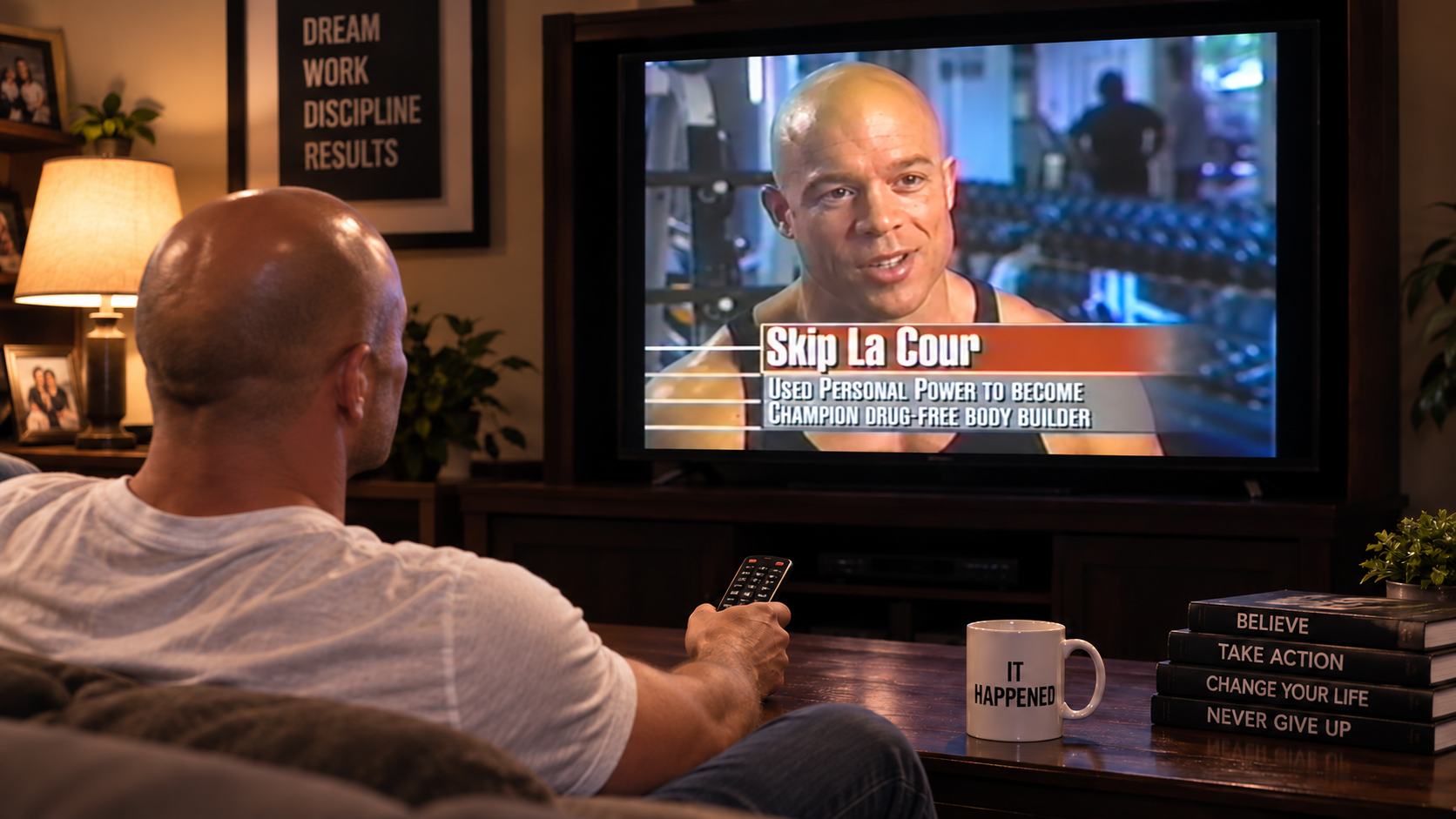
He wanted to know how I ended up appearing in a Tony Robbins infomercial.
It sounded like a simple question.
It was not.
The answer was not one lucky break, one bodybuilding contest, one seminar, one television appearance, or one decision to quit my job.
The real answer is a journey.
It is a journey through ambition, uncertainty, missed opportunities, discipline, fear, bodybuilding, personal development, writing, business, failure, risk, reinvention, and a growing understanding of what truly changes another person’s life.
When Frank asked me that question, I began telling him the story. The more I talked, the more I realized that the story explained almost everything about who I am today.
It explains why I believe mindset matters.
It explains why I coach the way I do.
It explains why I care about more than workouts, sets, repetitions, calories, protein, and body fat.
It explains why I spend so much time talking to one man, understanding his personality, listening to his fears, challenging his interpretations, and helping him follow through.
It explains why fitness is often only the doorway into a much larger transformation.
And it explains why a man who first saw me on television around 1999 could reconnect with me almost 30 years later and begin his own 12-week coaching journey.
That is the power of a life’s work.
That is the power of planting seeds.
And this is the complete story behind mine.
I Was Ambitious, but I Did Not Have Direction
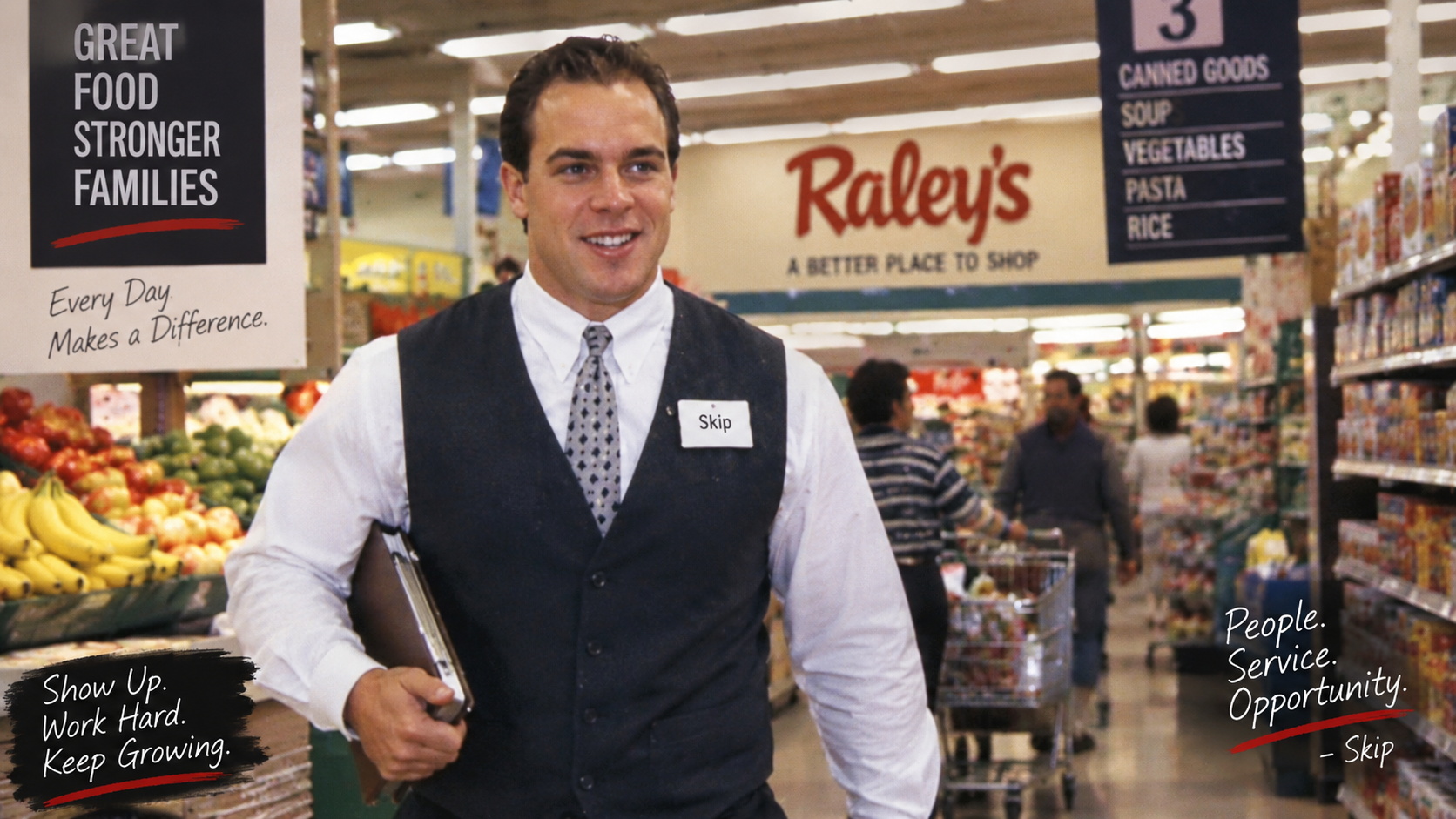
When I was 21 years old, I was already ambitious.
I worked hard. I wanted to succeed. I was moving up the ladder at a grocery-store chain and becoming one of the youngest men to hold significant responsibility in that organization.
I knew how to work.
I knew how to compete.
I had played sports throughout my youth, and I understood effort, toughness, and performance.
What I did not have was a clear philosophy for directing my ambition.
I had experienced missed opportunities.
My family had faced financial challenges. My parents had helped put my older brother and sister through college, but by the time it was my turn, the money was no longer there.
I had attended private schools during my childhood. I had athletic ability. There may have been paths available to me through college, junior college, and sports.
But I did not have enough direction.
I did not have someone consistently showing me how to think through those opportunities, how to position myself, how to develop confidence, or how to turn potential into a systematic plan.
That absence of direction affected me.
It is one of the reasons I am so involved in guiding my own children today.
I understand that guidance does not guarantee success. A father cannot perform the work for his son or daughter. He cannot eliminate every disappointment. He cannot prevent every wrong decision.
But he can provide distinctions.
He can help his children recognize patterns.
He can challenge them to think beyond the crowd.
He can teach them that leadership sometimes requires standing apart.
He can help them understand that extraordinary goals demand extraordinary standards.
That is what I now try to do with my son, Jayce, and my daughter, Brooklyn.
The systems I use with my family—the Family Power Board, our discussions about gratitude, confidence, happiness, courage, leadership, and identity—did not appear out of nowhere.
They grew from the personal-development education that entered my life when I was 21.
The Coworker Who Changed My Life
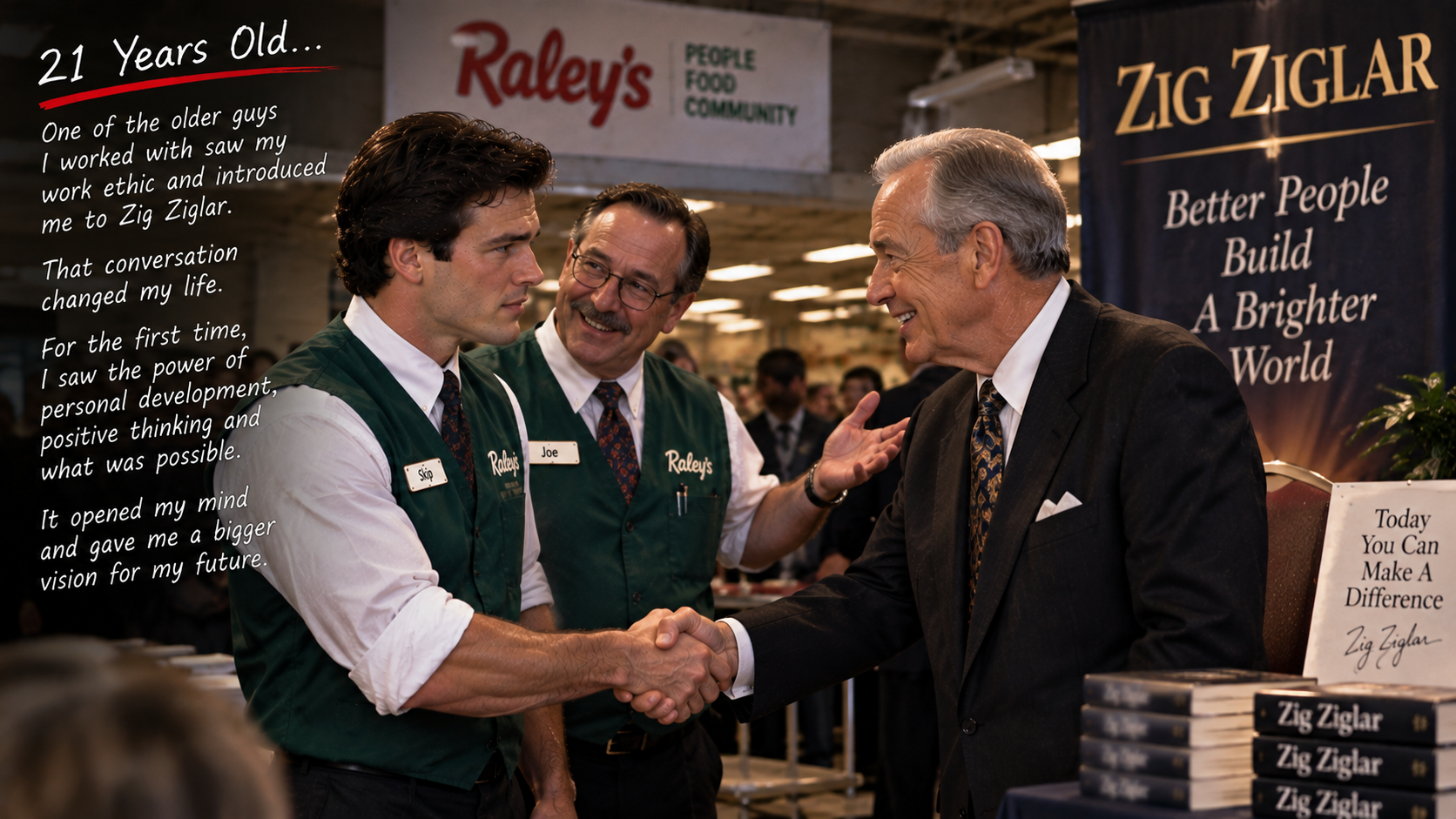
At the grocery store, there was a man working under my supervision.
I was technically his boss, even though he was older than I was.
He was a very good man, a strong Christian, and someone who believed deeply in the teachings of Zig Ziglar.
He had lived more life than I had. He had owned or operated other businesses before coming to work at the grocery store, and he had connections with people in the company.
We developed a friendship.
He saw something in me.
More importantly, he introduced me to a world I did not know existed.
He persuaded—or, as I sometimes say, dragged—me to a Zig Ziglar seminar in San Francisco, about an hour and a half away.
That seminar changed the direction of my life.
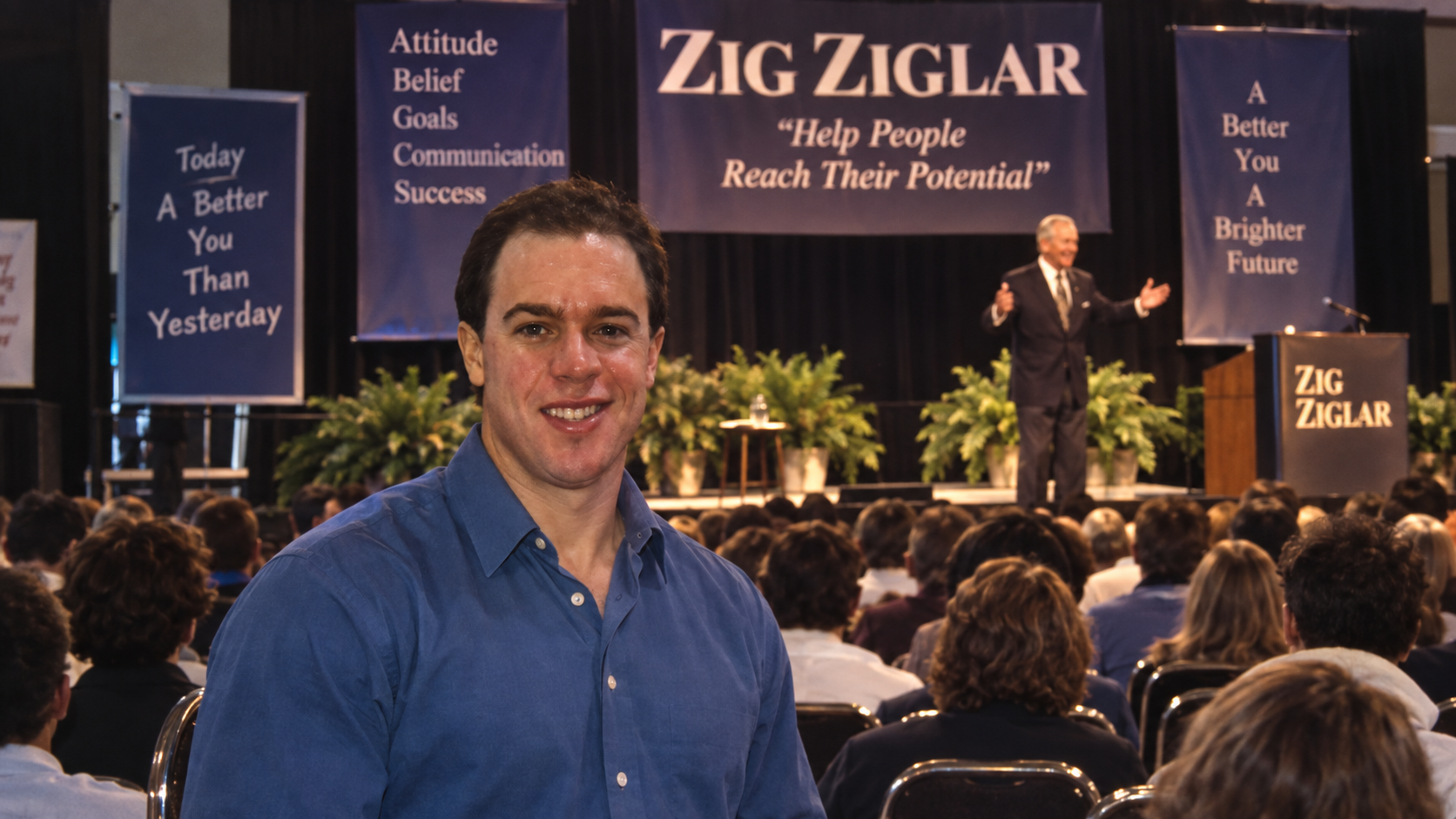
I had never been exposed to success principles in that form.
I knew what hard work was. I knew what competition was. I knew that some people achieved more than others.
But I had never heard anyone break success down into principles.
I had never heard someone explain how attitude, belief, expectations, self-image, communication, goal setting, and disciplined thinking affected achievement.
It was as though someone turned on a light in a room I had been trying to navigate in the dark.
I realized that people studied success.
They studied the mind.
They studied motivation.
They studied why one person moved forward while another person with equal or greater talent remained stuck.
I became obsessed.
Years later, when I passed through town, I met that coworker again. By then, he was around 80 years old.
I could look back and understand the size of the gift he had given me.
He did not hand me a career.
He did not give me money.
He did not lay out every step of my future.
He exposed me to an idea.
Sometimes that is enough to redirect an entire life.
I Began Feeding My Mind
After that Zig Ziglar seminar, I wanted more.
I read the books.
I bought the cassette programs.
I studied other personal-development teachers.
I discovered material from people such as Norman Vincent Peale and the earlier pioneers of positive thinking. I became interested in classic success literature and ideas represented by books such as Think and Grow Rich.
I entered the Nightingale-Conant world of audio education.
In those days, these programs were a major financial commitment.
A program might cost $300 or $400—real money for a young man working in a grocery store.
There were cassette collections, audio magazines, workbook packages, and complete courses from different authors and speakers.
I built a library.
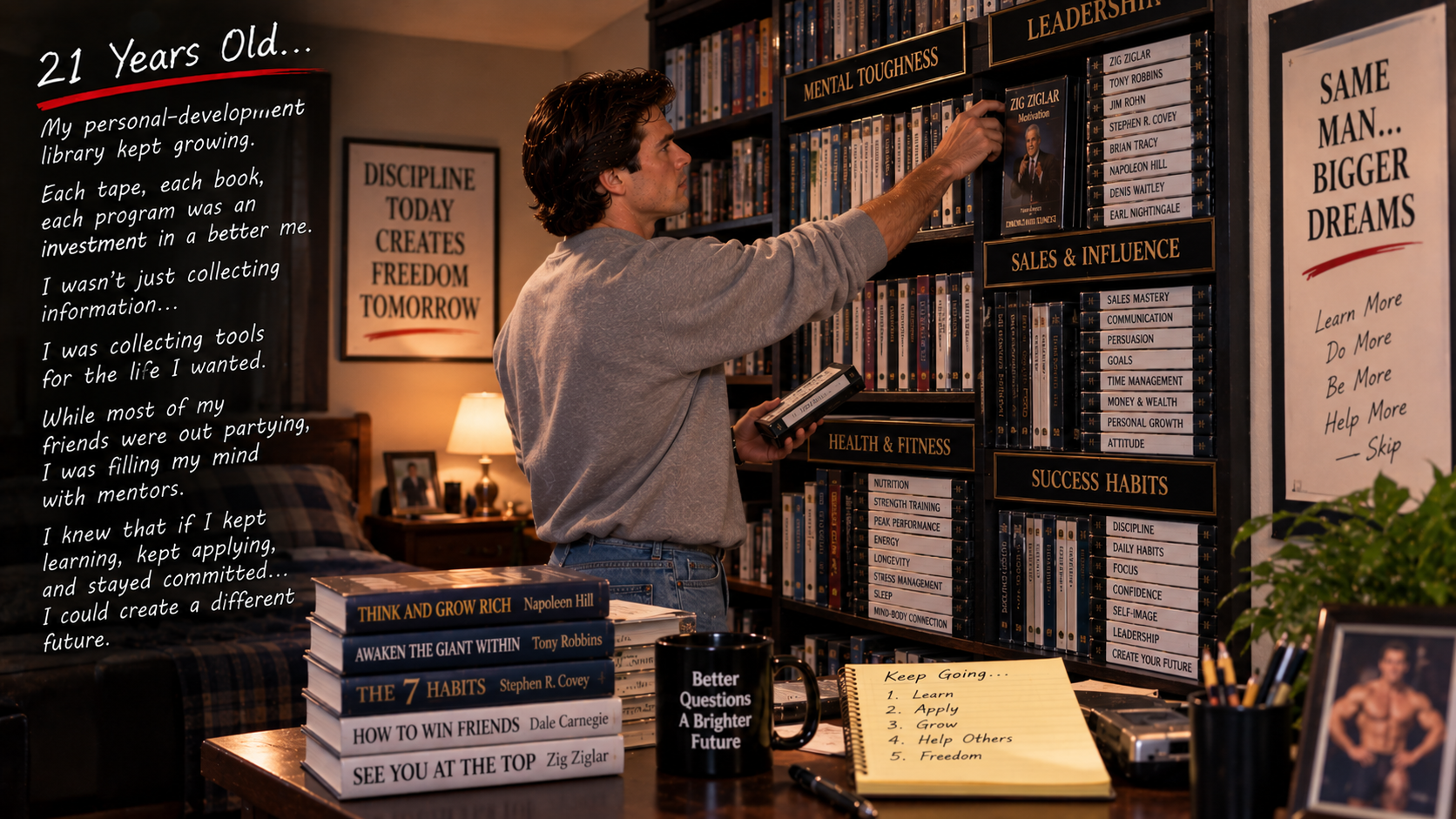
I worked the night shift, which meant I had hours during the day when I could listen.
I fed my mind constantly.
I did not casually consume the material.
I immersed myself in it.
That distinction is important.
Most people encounter a useful idea and think, “That makes sense.”
Then they move on.
I wanted to understand why it worked.
I wanted to install it.
I wanted to condition myself with it.
I wanted those ideas to become part of how I automatically interpreted pressure, opportunity, fear, disappointment, and ambition.
That became a lifelong process.
I have now spent more than four decades studying personal development—not merely as interesting information, but as something to apply to my career, my body, my family, my business, my coaching, and my identity.
Where Bodybuilding and Personal Development Came Together
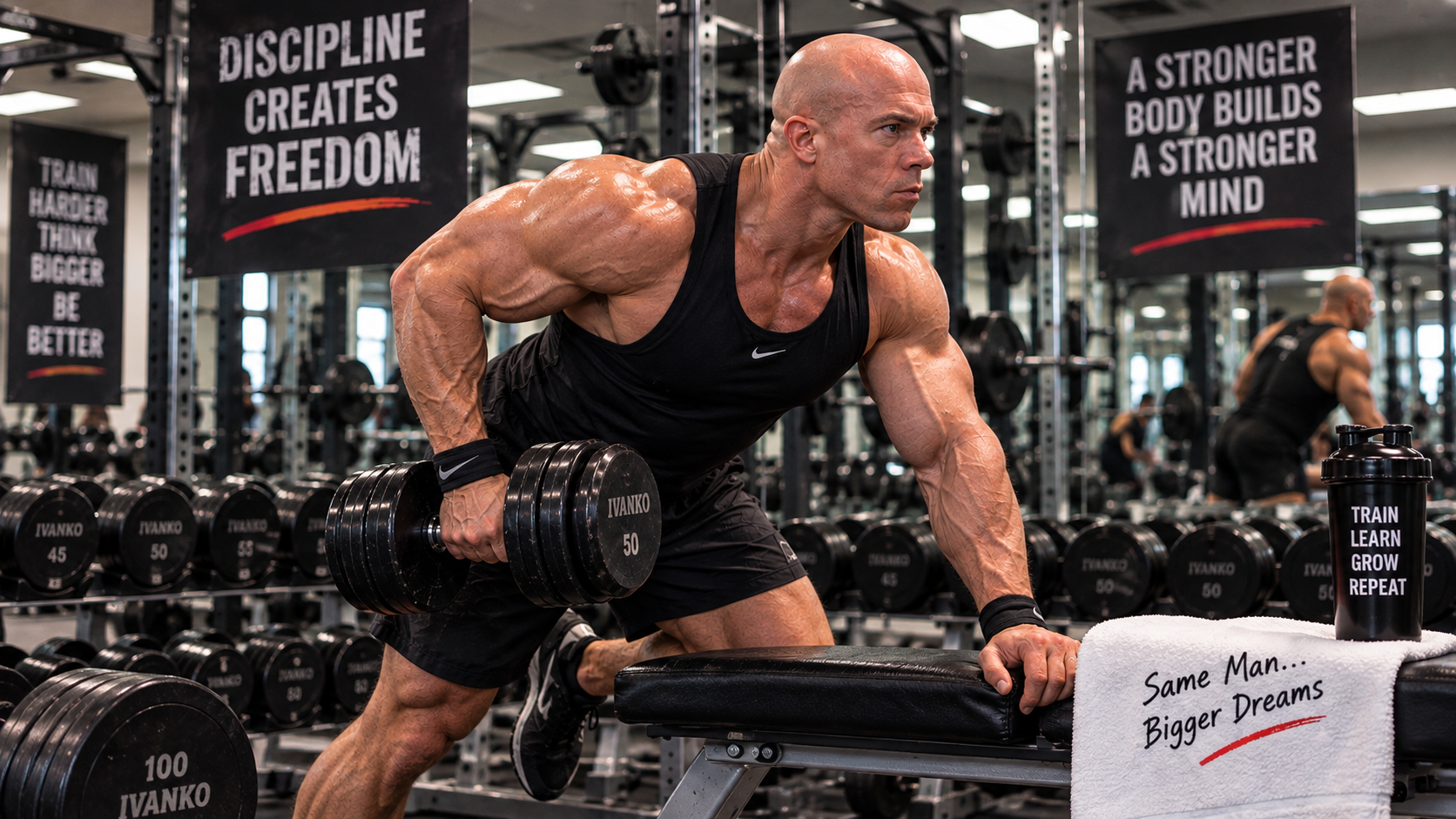
Bodybuilding eventually became the arena where I tested these principles.
It was one thing to listen to someone talk about vision, commitment, and discipline.
It was another thing to apply those ideas when I was hungry, exhausted, uncertain, doing cardio twice a day, preparing for a contest, and chasing a goal nobody could guarantee I would reach.
Bodybuilding gave personal development a physical form.
You could see whether I followed through.
You could see whether I stayed disciplined.
You could see whether I managed my emotions.
You could see whether I continued working when the outcome was uncertain.
In 1993, I placed second in the heavyweight class at the Musclemania competition.
The event received extensive television exposure. ESPN needed programming to fill late-night and overnight airtime, and the competition was replayed repeatedly.
This was before social media.
There was no YouTube channel to build.
There was no Instagram page.
There was no TikTok Live.
Television exposure was enormously powerful.
People throughout the bodybuilding world saw me. Regular viewers who were not deeply involved in bodybuilding saw me too.
That attention helped establish my name.
At the same time, drug-free bodybuilding was beginning to gain more visibility.
A major opportunity was developing: a truly drug-tested event connected with the chance to represent Team USA.
In the past, athletes could enter non-tested national competitions, and those who could pass a drug test might qualify for international representation even if they had not placed near the top of the overall contest.
The new event offered something different.
The classes themselves would be drug tested.
The winners would earn the opportunity to represent their country.
When I heard about it, I became consumed by the goal.
I wanted to win.
I wanted to represent Team USA.
I wanted to help put natural bodybuilding on the map.
Ninety Minutes a Day on a Stationary Bike
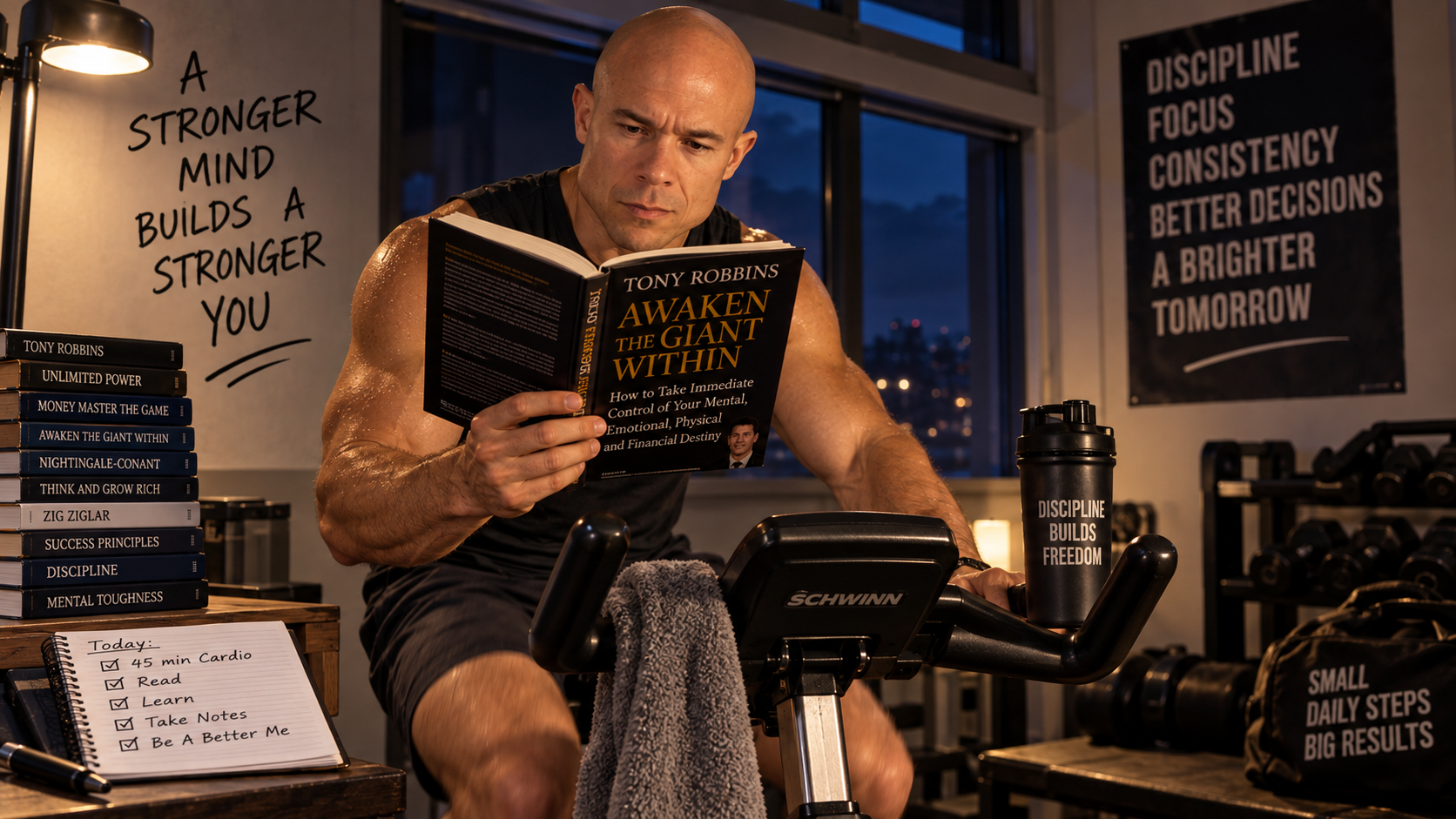
During that preparation, I performed approximately 45 minutes of cardio in the morning and another 45 minutes at night.
I lived in a third-floor apartment.
I spent a tremendous amount of time on that stationary bike.
I decided that I would not waste those hours.
I would train my body and my mind at the same time.
One of the books I read during those sessions was Tony Robbins’ Awaken the Giant Within.
It was a large book—hundreds of pages.
I have never thought of myself as someone who casually devours every book he picks up. I have read many books over my lifetime, but I do not finish every one.
I finished that one.
I read it while pedaling.
I was deeply affected by it.
I had already purchased Tony Robbins audio material in an earlier format, but a new CD version became available. At that time, an eight-disc CD player felt like exciting technology.
I bought the program again.
The CDs gave me a practical way to work through the material while doing cardio.
This time, I did more than listen passively.
I had a workbook.
I had two dedicated 45-minute sessions each day.
I was preparing for one of the most important competitions of my life.
I was excited, scared, ambitious, uncertain, and working relentlessly.
That emotional state tied the material to me.
I was not listening to personal development from a comfortable chair while casually imagining a better future.
I was living inside a test.
Would my work pay off?
Would I be good enough?
Could I control my fear?
Could I maintain my discipline?
Could I become the man I kept imagining?
The Tony Robbins material became part of that journey.
The Gift Certificate That Led Me to the Seminar
Inside the CD package was a gift certificate or promotional credit for a Tony Robbins seminar in San Francisco.
I had read the book.
I had listened to the program.
I had formed an emotional connection with the material during months of contest preparation.
I decided to attend.
I had no idea what a Tony Robbins event was like.
There was no endless collection of internet clips showing the music, dancing, shouting, audience participation, emotional exercises, and rock-concert atmosphere.
I thought I was going to a seminar where I would sit down and listen to someone talk.
I arrived only a few minutes before the scheduled starting time.
Experienced attendees had been lining up for hours to get close to the stage.
There were approximately 5,000 people in attendance.
I ended up in one of the worst seats in the building—far in the back and off to the side.
That seating location eventually became part of the lesson.
The Simon Says Lesson
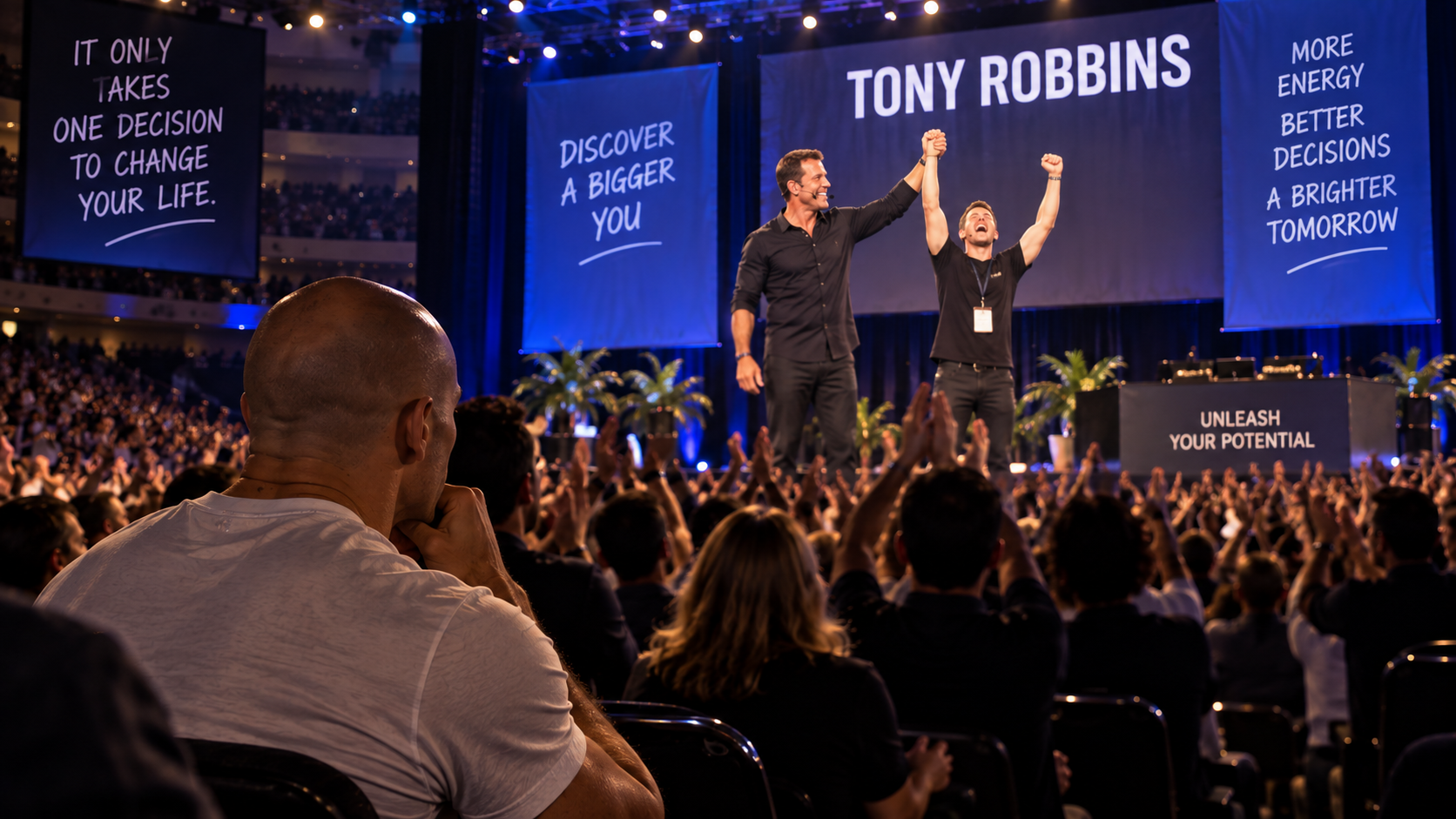
During the seminar, Tony conducted a large game of Simon Says.
He told the audience that there would be an excellent prize.
Thousands of people participated.
Most were eliminated almost immediately.
Tony stopped and reminded everyone that the prize would be worth winning. He encouraged them to focus.
They tried again.
Once more, most people were eliminated within only a few commands.
He gave them another chance.
The same pattern occurred.
Eventually, after the game narrowed down to only a few highly focused participants, one man won.
That man came onto the stage with Tony Robbins.
By that point in the seminar, being onstage with Tony felt like a major reward. Thousands of people looked at the winner and thought, “I wish that were me.”
Tony then explained the lesson.
The audience had been told there was a prize, but they did not know exactly what it was.
Because they could not clearly see the reward, they had not focused with the necessary intensity.
Once they saw the winner standing onstage, almost everyone believed they could perform better if given another chance.
They now knew what they wanted.
They had a target.
They had an emotionally compelling picture.
That lesson stayed with me.
You can work hard without being fully focused.
You can say you want success without having a clear picture of what success means.
You can participate without committing.
When the outcome becomes vivid, your attention changes.
Your resourcefulness changes.
Your standards change.
Your willingness to tolerate discomfort changes.
That idea became part of how I approach goal setting and how I coach other men.
How I Got Tony Robbins to Notice Me from the Worst Seat
I wanted to speak during the seminar.
I wanted to tell Tony what the material had meant to me and how I was applying it.
But there were 5,000 people in the room.
I was seated in the back corner.
Thousands of people raised their hands whenever Tony asked for someone to contribute.
I thought about one of the principles being taught: if you are resourceful enough, you can find a way to move toward what you want.
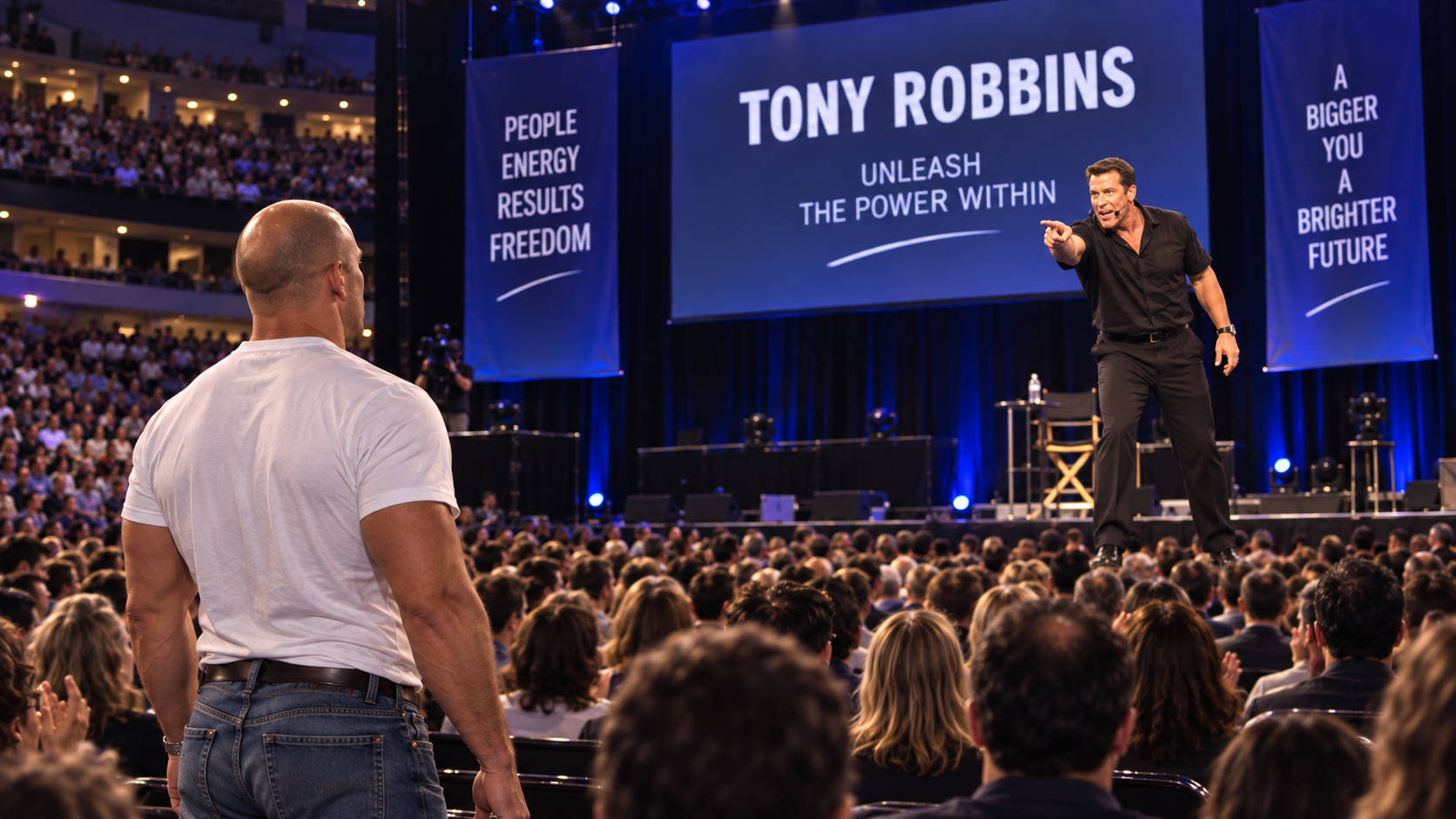
I developed a strategy.
Throughout the seminar, Tony kept the audience moving. People stood, danced, participated, and then sat down for the next segment.
When everyone was instructed to sit, I waited.
I let all the other 4,999 people sit first.
I remained standing in my white T-shirt, muscular and highly visible against the seated crowd.
Only after the entire room settled did I sit down.
I did it intentionally.
From the stage, Tony glanced toward the back corner.
He saw me.
He understood the message.
Later, when thousands of hands went into the air, Tony pointed in my direction.
“You in the corner.”
A microphone made its way back to me.
I spoke about my life.
I explained that I was working hard, competing in bodybuilding, writing for the muscle magazines, and making money selling nutritional programs.
But I still had my grocery-store career.
I said that what I had learned at the seminar had made me decide to quit my job and go after my dream.
The arena erupted.
Music played.
The audience celebrated.
It was a peak emotional moment.
But there was another side to the experience.
After the excitement faded, people approached me and congratulated me.
“That is incredible. You are quitting your job!”
I remember thinking, “I am doing what?”
I had worked for that company for approximately 15 years.
I had worked my way into a strong position.
I had stability, income, benefits, and security.
I had said something publicly in a room of 5,000 people that sounded inspiring.
Now I had to decide whether I truly meant it.
That is the difference between emotional excitement and a life-changing decision.
Becoming More Involved in the Tony Robbins World
After that experience, I went deeper.
I attended more seminars.
I bought the larger and more expensive packages.
I studied the programs rather than merely owning them.
I became part of the volunteer and event environment.
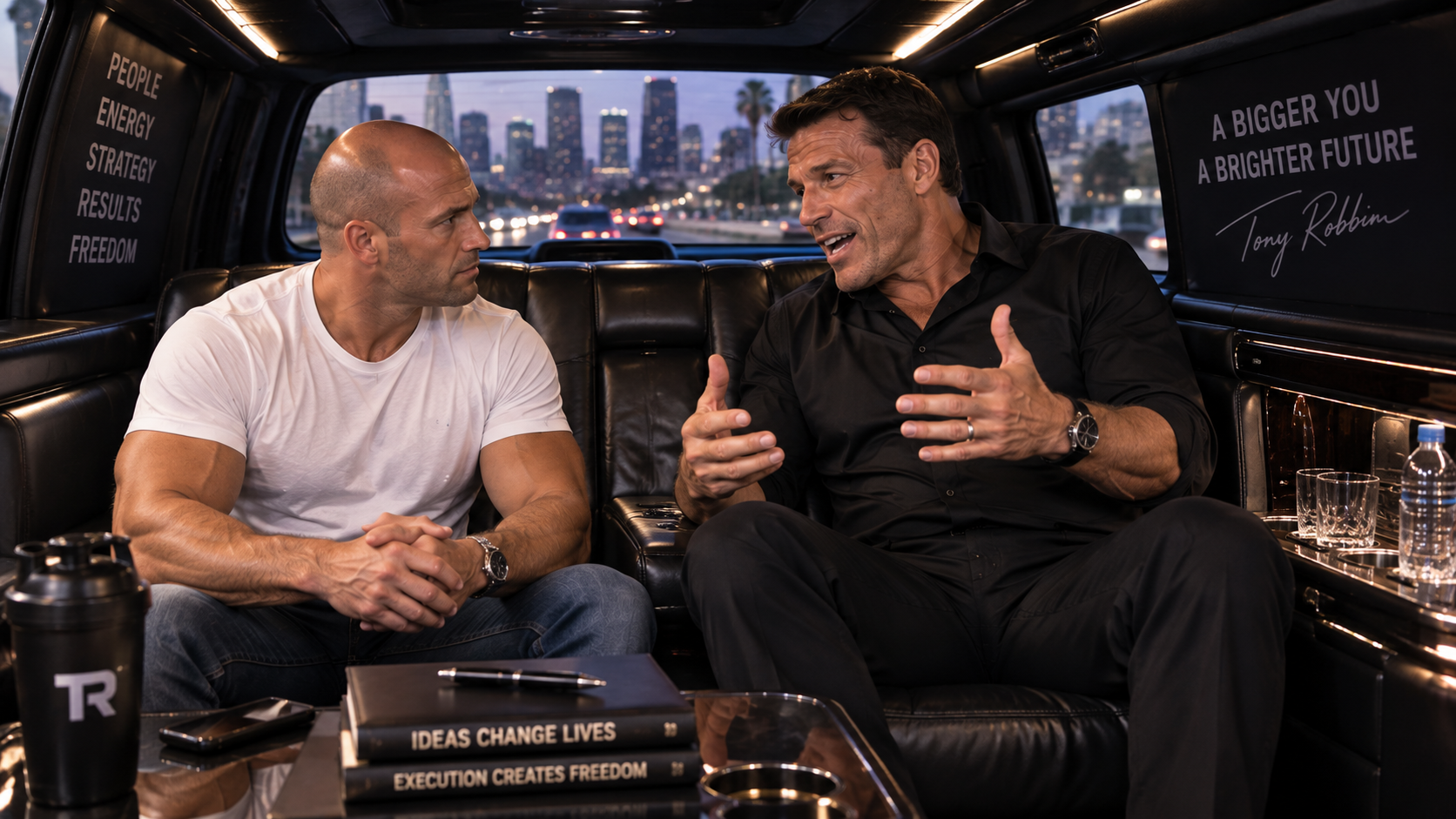
Because of my size, physical condition, presence, and reliability, I sometimes helped in a role that was essentially personal security or a bodyguard function.
I was not Tony Robbins’ friend, and I do not pretend that we had a personal friendship.
But I had unusual access at certain events.
I helped prepare him for appearances.
I was present while his microphone was being attached.
I rode in a limousine from a hotel to an event with him.
I saw parts of the production and performance environment that most seminar attendees never saw.
Those experiences gave me a closer view of how a major communicator managed energy, psychology, presentation, audience engagement, branding, and influence.
The Goal That Had No Obvious Path
At some point, I made a decision:
I was going to appear in a Tony Robbins infomercial.
There was no application form.
Nobody announced that they were looking for success stories.
I did not know when another infomercial would be produced.
I did not know how people were selected.
I did not know whether they needed someone like me.
I did not know anyone who had successfully pursued that goal.
There was no roadmap.
I simply decided that it was going to happen.
Then I asked myself what would need to be true for Tony Robbins and his company to choose me to represent their message.
First, I would need to become an undeniable example.
I would need to succeed in bodybuilding.
I would need to remain drug free.
I would need to become a leader.
I would need to write strong articles.
I would need to build a business.
I would need to live the principles.
I could not merely talk about being “the product of the product.”
I had to demonstrate it.
In my mind, I also believed I needed to quit my grocery-store job and commit fully to the fitness industry.
Whether that was objectively required did not matter.
I believed it was required.
That belief affected my standards.
Mark Leon and a Relationship Built Before I Needed Anything
There was a young salesman at the Tony Robbins organization named Mark Leon.
I knew him only as a voice over the phone.
I may have originally bought event tickets or products through him.
I formed a strategy.
Whenever I recommended Tony Robbins’ programs to someone, I referred that person to Mark.
I did not ask for part of his commission.
I was not trying to create a formal business arrangement.
I simply wanted to help him.
I believed that creating value for someone inside the organization might matter someday.
This was during the early internet era.
I was building websites as far back as approximately 1994, when creating a site required much more technical knowledge than it does today.
There was no social media ecosystem.
Still, I used my online presence to discuss Tony’s work and direct interested people to Mark.
I went to the seminars.
I purchased the programs.
I studied them.
I promoted what I genuinely believed in.
I built a relationship by helping before I ever needed to ask for help.
The Call Over the Grocery-Store Intercom
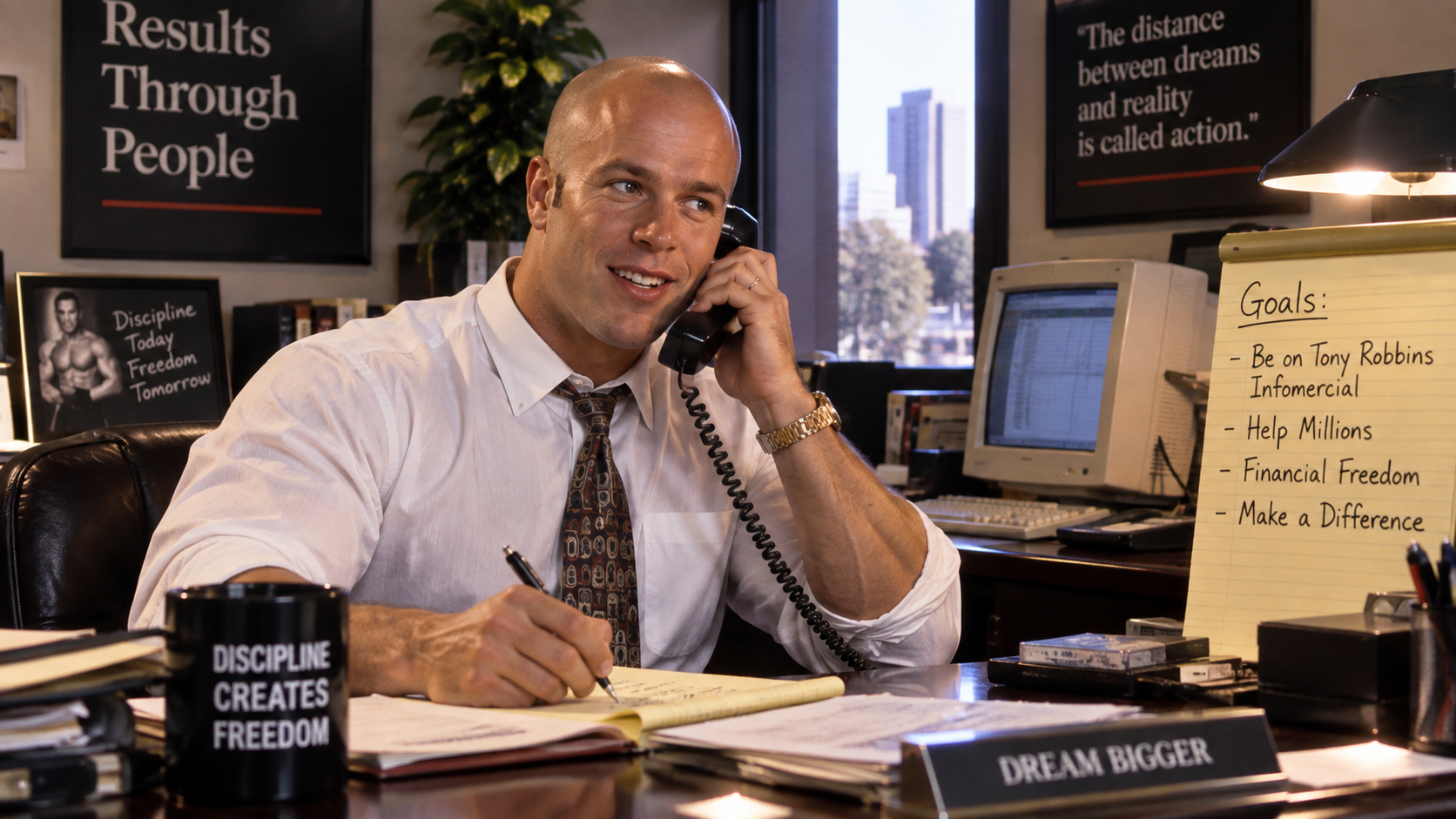
One day, while I was at work, the store intercom announced that I had a call on one of the grocery lines.
It was Mark Leon.
He told me that the company was preparing another infomercial.
The organization had asked for examples of people who had experienced success through Tony’s work.
Mark had submitted my name.
He could not make any promises.
There was no guarantee I would be selected.
But suddenly, the outrageous goal I had invented in my own mind had a possible path.
I had never even told Mark that appearing in the infomercial was my goal.
I had simply worked my plan.
I had tried to become an example.
I had supported him.
I had immersed myself in the material.
I had positioned myself.
Now an opportunity had appeared.
That phone call intensified everything.
I felt that I had to follow through.
Leaving the Grocery Business
Walking away from the grocery-store career was not easy.
I had invested approximately 15 years in that business.
I had worked my way up.
I was still relatively young—around my mid-30s.
The income was strong for the time.
The company offered stability and benefits.
I did not impulsively give two weeks’ notice and disappear.
I gave an extended notice—approximately six months.
That long transition created its own form of pain.
For months, I had time to question myself.
Was I making a mistake?
Was I abandoning security for an unrealistic dream?
Was I confusing seminar emotion with sound judgment?
Could I really build a sustainable life in bodybuilding, writing, coaching, and fitness?
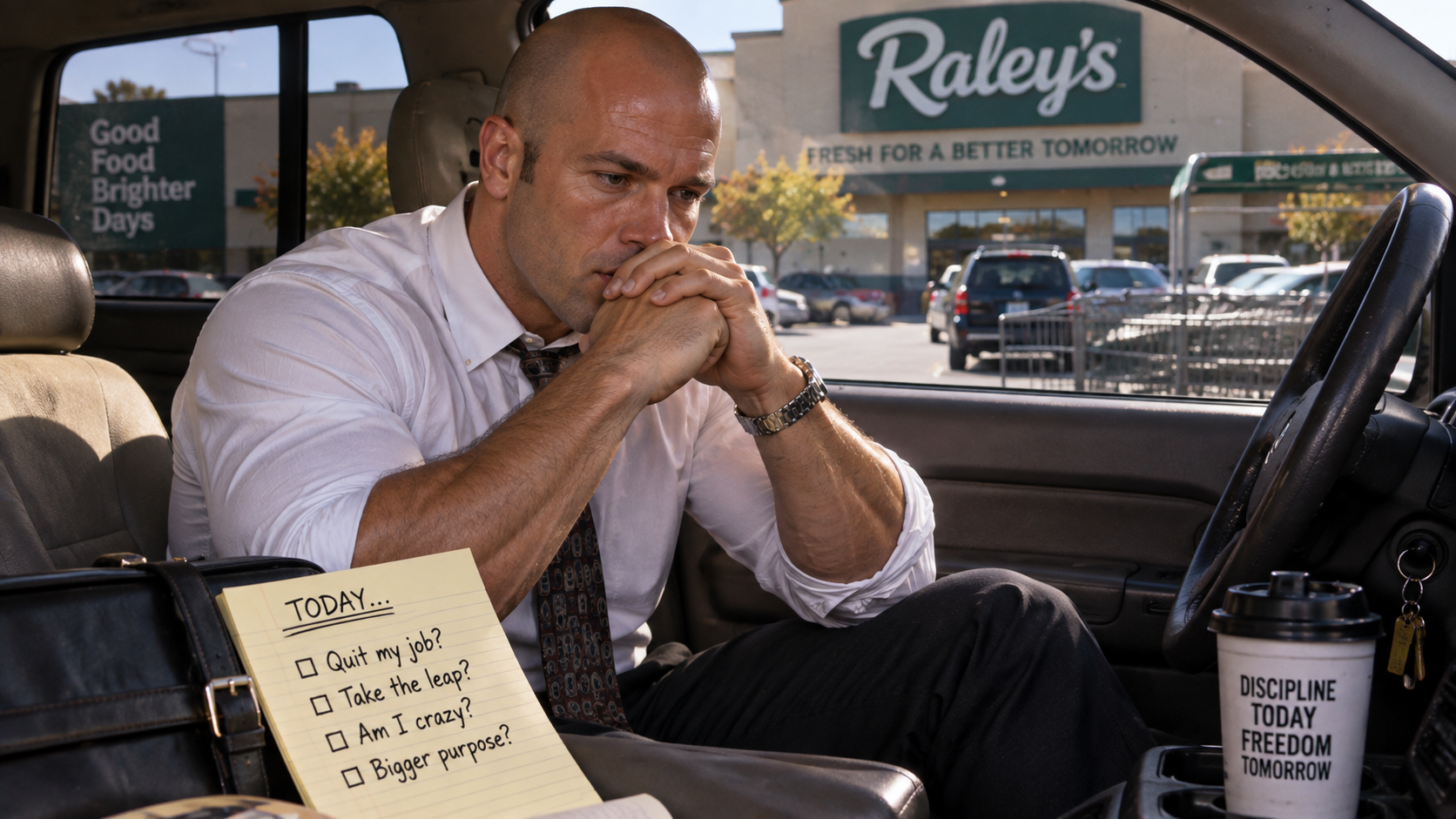
On my final day, I sat in my car in the parking lot.
I could not make myself go inside.
I sat there for what may have been close to an hour, thinking:
“What are you doing?”
That is an important part of the story.
Courage is not the absence of fear.
A big decision does not always feel powerful.
Sometimes the decision that eventually defines your life feels terrifying, lonely, and potentially foolish while you are making it.
The Infomercial Did Not Happen Immediately
Even after my name was submitted, there were more steps.
I received another call while attending one of Tony’s intensive seminars—an expensive, emotionally demanding program similar to the event later portrayed in I Am Not Your Guru.
The production team wanted to film a segment with me.
That still did not guarantee inclusion.
An infomercial requires more than an inspiring story.
The person must be believable.
He must communicate well.
He must look appropriate on camera.
His story must fit the larger marketing message.
The segment was filmed.
Then I waited.
Eventually, I learned that I had been selected.
The infomercial began playing around 1999, based on my recollection.
It aired repeatedly for several years and reached people throughout the world.
At approximately the same time, I had other television exposure connected to bodybuilding and supplement-industry advertising.
I had created a remarkable level of visibility from a goal that originally existed only in my mind.
There had been no obvious path.
I decided what I wanted.
I asked who I would need to become.
I created relationships.
I positioned myself.
I worked.
I took risks.
And eventually, the opportunity appeared.
The Magazine Dream
The Tony Robbins story was only one part of what was happening.
I was also developing a writing career in the muscle magazines.
Today, anyone can publish an article instantly.
In those days, the bodybuilding magazines controlled access to the audience.
If the magazines did not feature you, most people did not know you existed.
There was no social media account where you could build your own following.
The editors and publishers were the gatekeepers.
I wanted to become a writer.
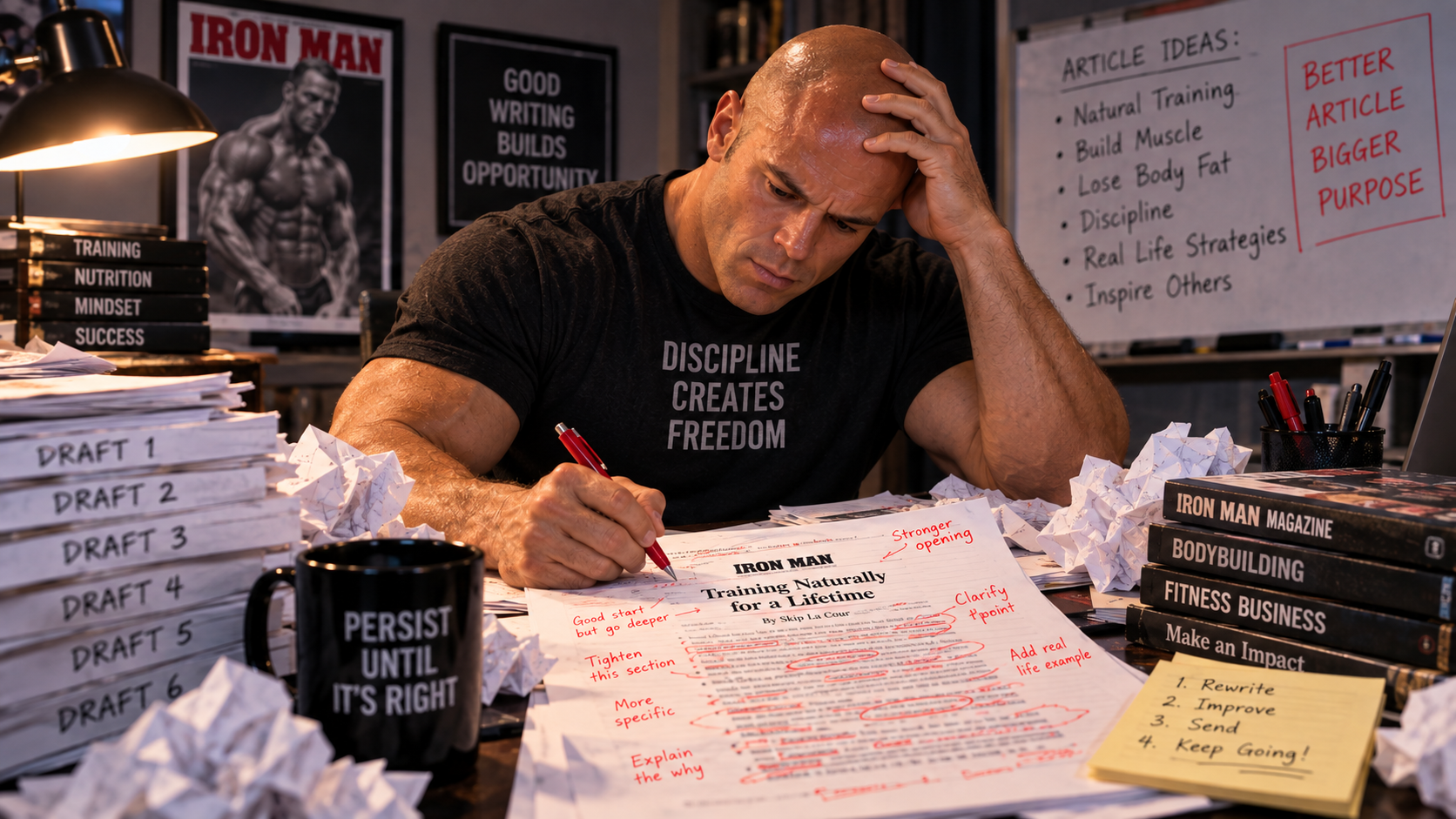
The first article I worked on was something like “How to Make It Big as a Drug-Free Bodybuilder”—a collection of lessons or tips for natural competitors.
My writing was not polished.
A woman who helped edit my work would send the pages back covered with corrections.
I rewrote that first article again and again.
It may have gone through 20 or more versions.
At the same time, Iron Man magazine announced that it would be involved with a natural bodybuilding competition.
The announcement came many months before the event.
I made another declaration:
I was going to win that competition.
Then I was going to approach the magazine with my article.
I trained for the contest while continuing to rewrite.
I became extremely lean and conditioned.
I won the heavyweight class and the overall title—just as I had envisioned.
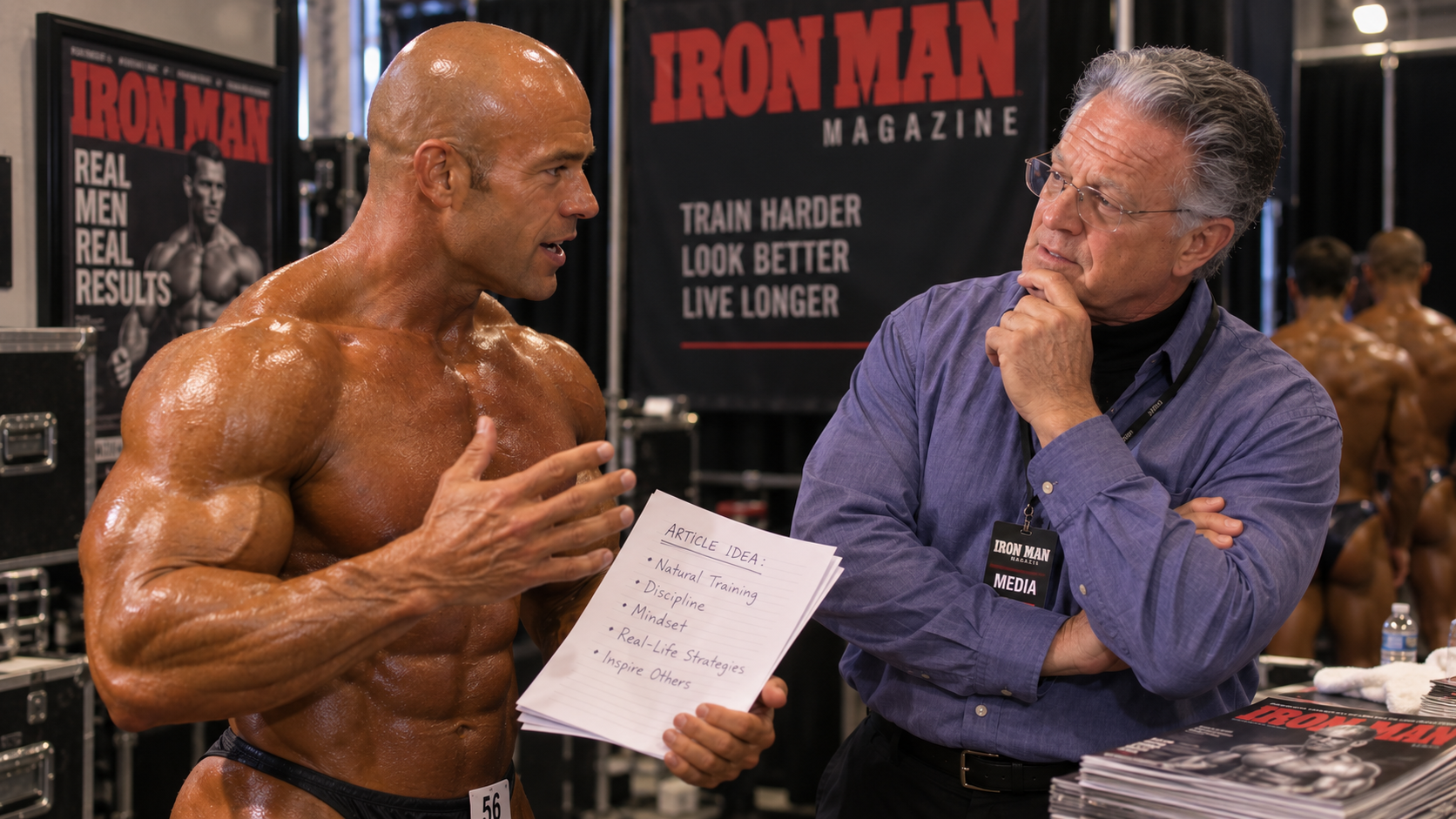
After the competition, I approached John Balik, one of the leading figures at Iron Man magazine.
There was only one problem.
My article still was not finished.
I introduced myself and explained that I had written—or was writing—an article for the magazine.
He asked whether I had it with me.
I had to admit that it was not ready.
I told him I would finish it and send it.
Eventually, I did.
My first article was published around 1995.
After that, I developed a remarkable record: the magazine accepted the articles I submitted.
Writing became another pillar of my career.
I learned how to translate experience into instruction.
I learned how to speak to the reader.
I learned how to organize an idea.
I learned how to take something emotional and confusing and turn it into a clear distinction.
That skill now plays an enormous role in my coaching and content.
The Nutritional Programs
Before the internet became what it is today, people regularly approached me for fitness and nutrition guidance.
I was good with computers, so I created a professionally presented nutritional program.
I began selling it locally.
At first, the price may have been $25.
Then it became $50.
Then $75.
Eventually, I sold the programs for approximately $99.
These were not generic pieces of paper.
I took time with people.
I conducted consultations.
I customized the plans.
I printed them professionally on a laser printer.
For that period, the presentation was impressive.
Word spread.
I sold the programs wherever I went.
The owner of a gym where I trained saw how well I was doing.
I once proposed that we work together, but he was not interested.
Later, I overheard him make a comment that I was earning more money in his gym than he was.
He may have been right.
He was responsible for rent, equipment, maintenance, staffing, cleaning, and all the overhead of running the facility.
I could walk in, talk to someone, provide a program, and generate nearly pure profit.
That success contributed to my desire to write for the magazines.
I had a larger vision.
I believed that if my articles appeared nationally, I could establish an 800 number and sell my nutritional programs throughout the country.
That is exactly what happened.
Then the opportunity became even larger.
Iron Man had editions and distribution in other countries.
My work reached readers internationally.
I began selling programs around the world.
From a business perspective, it was working.
But another twist changed my direction.
Why I Stopped Selling Something That Made Money
The nutritional programs were good.
I believed in them.
I delivered what I promised.
If people followed the plans, I believed they would achieve results.
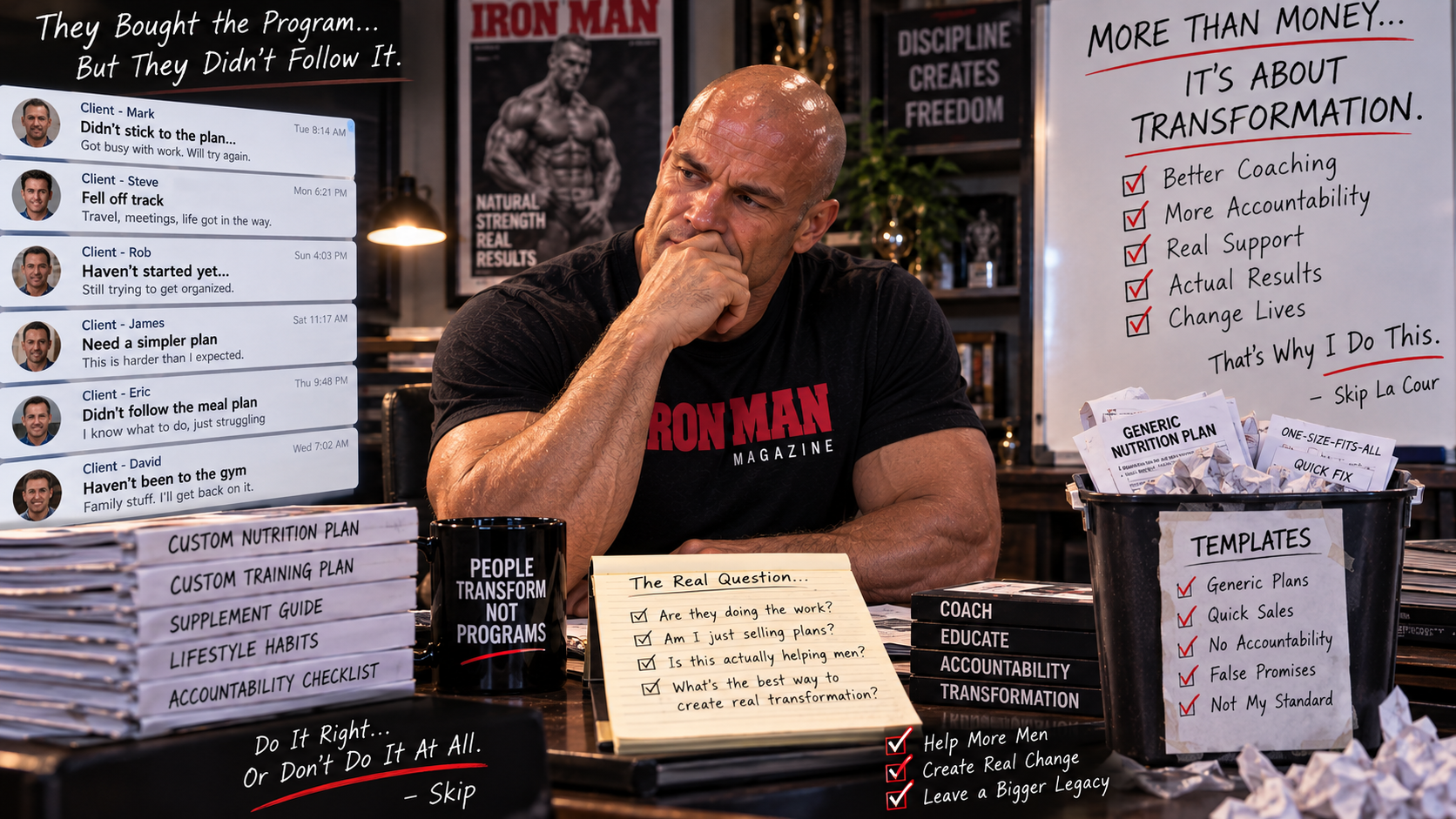
But many people did not follow them.
They bought the information.
They received the customized plan.
Then they put it aside.
Later, they would tell me:
“I need to get back to that program.”
“I never really used it.”
“I know I should be following it.”
They did not have an information problem.
They had a follow-through problem.
I could have told myself that their execution was not my responsibility.
I had delivered the product.
I had fulfilled my side of the agreement.
The money was good.
The demand existed.
Nutrition information has always been easy to sell because people love the hope of a new plan.
But the business stopped feeling fulfilling.
I did not want people merely to buy my information.
I wanted the information to change them.
I eventually stopped selling those programs, even though I could have continued making money.
That decision revealed something important about me.
I was not most fulfilled by the transaction.
I was fulfilled by the transformation.
Information Is Not Enough
This is why I am so passionate about one-on-one coaching today.
Information is everywhere.
A man can find a workout routine in seconds.
He can calculate his calories.
He can search for a list of high-protein foods.
He can watch thousands of videos.
He can buy books, courses, meal plans, applications, supplements, and training programs.
The problem is not usually that he has never heard the information.
The problem is interpretation.
Application.
Consistency.
Certainty.
Emotional control.
Self-awareness.
The ability to continue when the novelty disappears.
A client may make a major breakthrough during a conversation with me even though I have not said anything that is completely new to the fitness world.
The breakthrough comes because I explain it in a way that applies directly to him.
I understand how he is interpreting the situation.
I understand what he is afraid of.
I understand where he is making the process unnecessarily complicated.
I understand the difference between the words he is saying and the concern underneath those words.
To him, the problem feels enormous.
It is his body.
His confidence.
His marriage.
His health.
His age.
His identity.
His fear that time is running out.
It is emotional and overwhelming because it is personal.
To me, the pattern is often clear.
I have coached hundreds of men one-on-one.
There are countless personalities, but the same core patterns appear repeatedly.
There are only so many reasons a man does not follow through.
There are only so many mistakes he makes while trying to build muscle and lose body fat.
There are only so many ways he confuses more effort with better judgment.
My job is not merely to provide facts.
My job is to communicate the facts in a way that gives that particular man clarity, confidence, and control.
Why I Make Myself Accessible
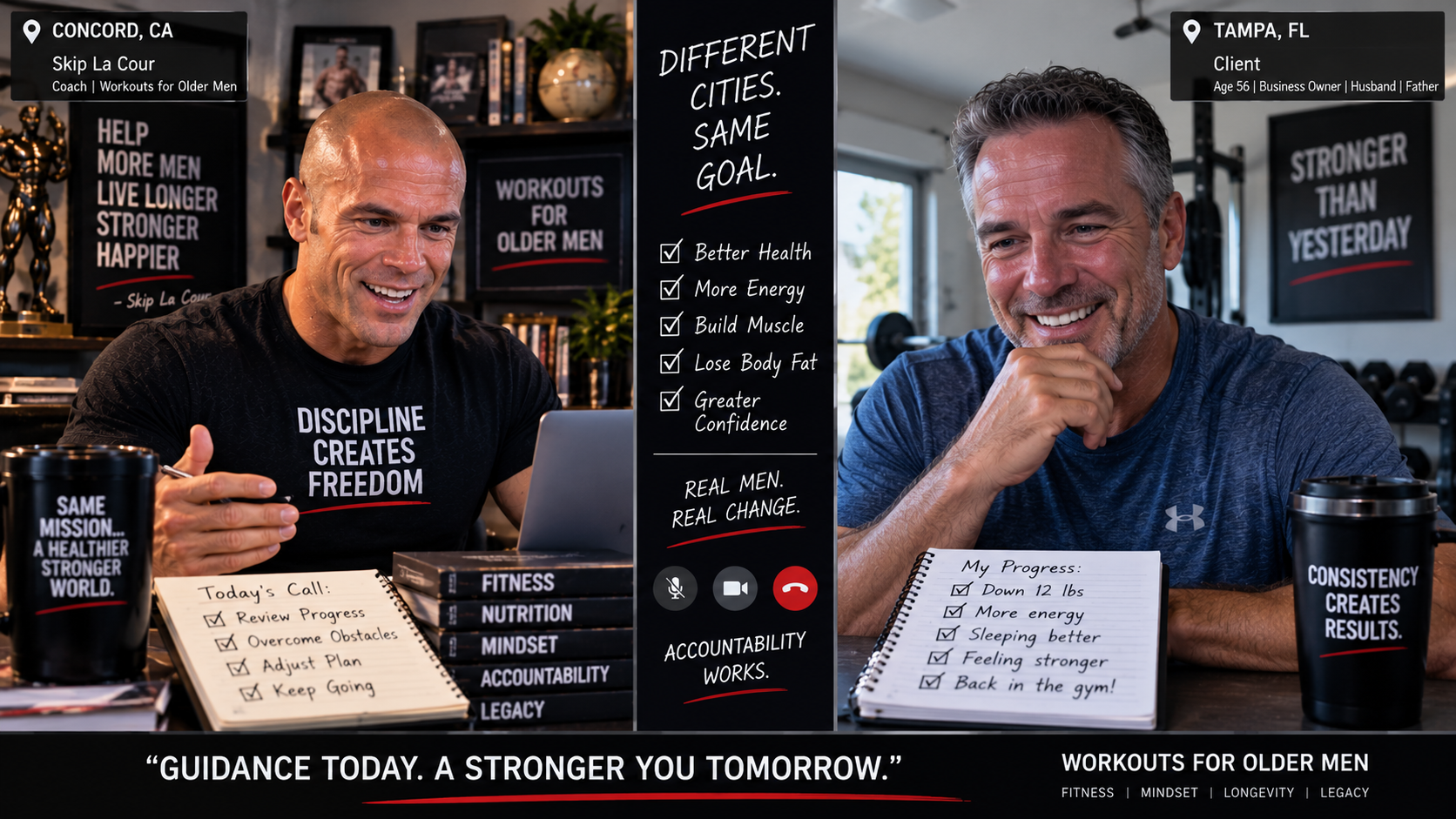
One-on-one coaching is not the easiest business model.
It is not the most scalable.
I could sell a supplement without speaking to the buyer.
I could sell a prerecorded video.
I could sell an ebook.
I could create a low-priced digital program and leave the customer to figure it out.
That would be more efficient.
But I know what often happens when people are left alone with more information.
I saw it decades ago with the nutritional plans.
Information is purchased.
Hope rises.
Life intervenes.
Confusion returns.
The program is placed on a shelf.
I make myself accessible because conversation makes a difference.
A man needs to know that someone understands what he is really saying.
He needs someone who will notice when he is rationalizing.
He needs someone who will challenge him without humiliating him.
He needs someone who can simplify the process without lowering the standard.
He needs someone who has taken risks, failed, adjusted, rebuilt, and continued.
That is why I care so much about changing one person at a time.
The Journey Was Not a Straight Line
I want to be careful not to turn this story into a fairy tale.
It did not unfold as a perfect climb from one victory to the next.
There were sacrifices.
There were relationships I may not have developed because of where I invested my time.
There were risks that did not pay off.
There were mistakes.
There were periods when the public image of success did not match the private uncertainty.
There were times when I achieved something and then had to reinvent myself again.
There were changes in the publishing industry.
The muscle magazines that once controlled the flow of information lost their dominance.
Print declined.
Iron Man magazine changed.
Video became more important.
Then short-form content changed the way people consumed information again.
I had to adjust.
Success in one era does not exempt you from adapting in the next.
You must keep learning.
You must keep communicating.
You must keep finding ways to make timeless principles relevant to the way people live now.
What All of This Has Given Me
The rewards from this journey go far beyond titles, magazine articles, television appearances, endorsement contracts, international travel, VHS products, websites, or money.
The greatest reward is the man I had to become.
I developed confidence by doing frightening things.
I learned how to create a vision without having every step.
I learned how to stay committed while uncertain.
I learned that public success usually has a private price.
I learned that information without implementation has limited value.
I learned how to communicate.
I learned how to mentor.
I learned how to take the principles I discovered as a 21-year-old and apply them to my children.
Today, when I challenge Jayce to use a wood bat while other players use modern metal bats, the lesson is larger than baseball.
It is about having the courage to be different.
It is about preparing for resistance.
It is about trusting a process that may feel harder in the moment but will make the future easier.
It is about becoming a leader rather than blending into the pack.
When I ask my family what they are grateful for, what makes them happy, and what they love about themselves, that practice connects back to the world I entered through Zig Ziglar.
When I help an older man see that his body is not the only thing he is rebuilding, that comes from decades of experience.
The body is often the first visible project.
But beneath the body, a man may be rebuilding his self-respect, certainty, discipline, leadership, marriage, ambition, and sense of possibility.
The Full-Circle Moment with Frank
Frank first became aware of me through the Tony Robbins infomercial around 1999.
At that time, I did not know him.
He was one person somewhere in the world seeing the result of a goal I had once invented without knowing how it could happen.
Nearly 30 years later, Frank and I connected.
Now he is not merely watching me on television.
He is working with me directly.
He is beginning a 12-week journey.
The infomercial planted a seed.
The seed remained.
Decades passed.
Life changed.
Technology changed.
The fitness industry changed.
The magazines changed.
I changed.
Frank changed.
But eventually, the connection completed itself.
That is extraordinary to me.
It reminds me that we do not always know the full effect of the work we are doing right now.
An article may reach someone who never contacts you.
A video may influence a person who is not yet ready.
A conversation may stay in someone’s mind for decades.
An example may become important at a completely different stage of that person’s life.
You do the work anyway.
You tell the truth anyway.
You become the example anyway.
You plant the seed anyway.
Fitness Is the Doorway, but the Mission Is Larger
Men often come to me because they want to lose body fat.
They want to rebuild muscle.
They want their clothes to fit differently.
They want to feel confident when they look in the mirror.
They want a clear workout and eating plan.
We address those things.
But the longer I coach, the more obvious it becomes that fitness is often the doorway.
A man begins by asking how many calories he should eat.
Soon we are discussing how he responds to uncertainty.
He begins by asking how many sets he should perform.
Soon we are discussing why he does not trust himself.
He begins by asking how to lose 20 pounds.
Soon we are discussing what kind of example he wants to be for his children.
He thinks he needs more information.
Often, he needs a stronger identity, clearer standards, better interpretation, and someone who will help him follow through.
That is where my entire journey comes together.
The 21-year-old grocery-store manager.
The Zig Ziglar seminar.
The cassette programs.
The Nightingale-Conant library.
The bodybuilding contests.
The stationary bike.
Awaken the Giant Within.
The Tony Robbins seminar.
The Simon Says lesson.
The white T-shirt in the back corner.
The public declaration.
The terrifying decision to leave my job.
The magazine articles rewritten again and again.
The bodybuilding victories.
The nutrition plans.
The international customers.
The disappointment when people bought information but did not use it.
The infomercial.
The risks.
The reinventions.
The hundreds of one-on-one conversations.
They were not separate chapters.
They were all training me for the work I do now.
Why I Coach One Man at a Time
I coach one man at a time because one man’s transformation matters.
I coach one man at a time because I know the difference between consuming information and changing your life.
I coach one man at a time because a man deserves more than another generic plan.
He deserves to understand what he is doing, why he is doing it, and how to continue doing it when his emotions change.
He deserves a process that fits his age, responsibilities, schedule, experience, and goals.
He deserves honest feedback.
He deserves clarity.
He deserves certainty.
He deserves someone who cares whether he follows through.
The sets and repetitions matter.
The calories and protein matter.
The cardio matters.
The sleep matters.
But the man performing those actions matters more.
That is the complete picture.
I am a fitness coach.
I am a bodybuilding champion.
I am a writer.
I am a student of personal development.
I am a husband and father.
I am a teacher of mindset, discipline, leadership, and personal responsibility.
And after more than four decades of studying success and nearly four decades of serious training, I am still doing what that coworker did for me when I was 21.
I am exposing another man to a different way of thinking.
I am helping him see possibilities he may not see by himself.
I am giving him distinctions that can redirect his life.
He may begin with fitness.
But we are building something much larger.
That is why I do this.
That is how I got here.
And that is the real story behind the muscle.
Your Coach,
Skip La Cour
Workouts for Older Men
(925)352-4366
Take These Two Easy Steps
1. Text Me Your Picture and Introduce Yourself. Text me a picture at 925-352-4366 so I can see where your body is now. I’ll be able to help you even better. A picture does indeed tell me a “1,000 words” and we’ll be more efficient with our time when we speak on the phone. Whatever you feel comfortable with is fine. I can tell a lot even with your shirt one.
2. Fill Out The Questionnaire Below. This questionnaire will help me learn more about you. Not only will it help me learn more about you and better serve your needs, it will help you gain more clarity as to what you want and what may be stopping you from getting it.
Expect me to reach out to you very soon. I’ll contact you by text, phone call, or email.
